If you are thinking “Is my internal Information Security Management System (ISMS) ready for ISO 27001 certification?” audit is essential for external validation. Ensuring your security posture meets the ISO 27001 standard requires rigorous checks. Skipping your internal audit can hide critical control gaps. How can you gain confidence that your ISMS processes and technical controls are effective and aligned with ISO 27001 compliance? This ISO 27001 internal audit checklist will guide you for technical review, identify nonconformities, and drive continuous improvement within your security management system isms.
Includes a downloadable checklist template + sample audit report you can customize.
What is ISO 27001 Internal Audit?
An ISO 27001 internal audit is your planned evaluation process for your ISMS. Independent auditors verify if your system meets the ISO 27001 standard requirements and your own documented security policies and procedures. This technical check confirms implemented controls operate effectively within the defined ISMS scope. It’s a key self-assessment step to manage information security risks and ensure your security management system functions correctly according to iso 27001 internal audit requirements. ISO 27001 readiness is also covered on our local cybersecurity pages for New York City and Chicago.
Why is it Mandatory for ISO 27001 Certification?
Conducting an ISO 27001 internal audit is mandatory under ISO 27001 Clause 9.2. It’s a critical ISO 27001 internal audit requirement for certification. This step provides objective evidence to external certification bodies that your ISMS is implemented and functioning. It shows you actively evaluate its performance against the iso 27001 requirements checklist. Performing this audit is essential proof that your system is ready for the external validation required for requirements for ISO 27001 certification and successful external audit.
What if you do not conduct an internal ISO 27001 Audit?
Failing to conduct an internal audit guarantees you will fail your external ISO 27001 certification audit. Certification bodies mandate seeing your internal audit records. Operationally, skipping this step means significant control weaknesses or process gaps remain hidden. You won’t identify these issues proactively. This leaves your organization vulnerable to security incidents and data breaches resulting from unmitigated information security risks. For example, weak access controls might go unnoticed until a breach occurs. Without audits, your security posture decays silently. This forces costly, reactive remediation instead of planned risk treatment. It halts continual improvement efforts, preventing your security management system isms from adapting to new threats, rendering your claimed compliance ineffective.
Download the editable version so you can tick items, assign owners, and track evidence.
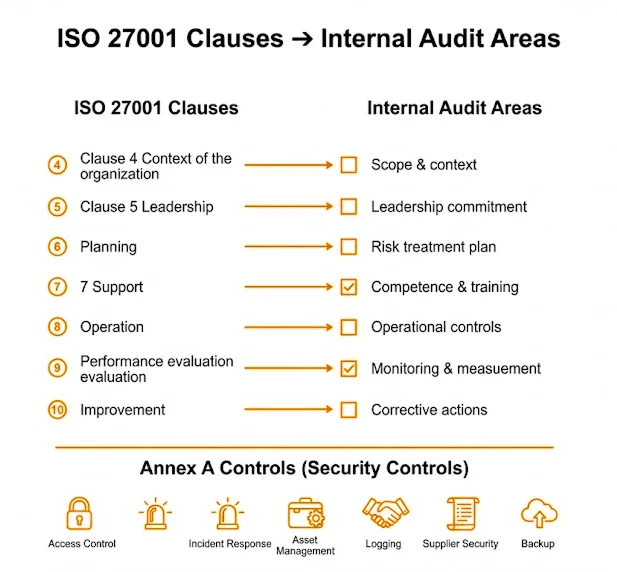
ISO 27001 Internal Audit Checklist
| Audit Area (Clause / Control Category) | Key Checks / Questions | Evidence to Review |
|---|---|---|
| Clause 4: Context | Is the ISMS scope technically defined and aligned with business boundaries and asset inventory? Does it cover relevant systems/data types? | ISMS Scope Document, Asset Inventory, Network Diagrams, Data Flow Maps. |
| Clause 5: Leadership | Is top management's commitment to information security and the ISMS evident? Are security roles/responsibilities clear, especially for technical staff? | Management Review Minutes, Security Policy Communication Records, Role Descriptions for Security/IT personnel. |
| Clause 6: Planning (Risk) | Is the risk assessment methodology defined and consistently applied? Are information security risks identified & analyzed for all relevant assets? Is the risk treatment plan documented, linking risks to controls? | Risk Assessment Methodology, Risk Register, Risk Treatment Plan, Risk Acceptance Records. |
| Clause 6: Planning (Objectives) | Are information security objectives specific, measurable, achievable, relevant, time-bound (SMART), and monitored? | Information Security Objectives Document, Performance Measurement Reports, Management Review Minutes. |
| Clause 7: Support (Resources, Competence, Doc) | Are necessary technical resources identified and available? Are personnel trained and competent? Is required documented information controlled? | Resource Allocation Records, Training Records, Competency Matrix, Document Control Procedures, Record Retention Policy. |
| Clause 8: Operation | Are planned operational activities performed? Are change management and incident response processes followed? | Procedure Documents, Change Logs, Incident Records. |
| Clause 9: Performance Evaluation (Monitoring) | Is monitoring and measurement of ISMS effectiveness performed? Are metrics defined and reviewed? | Monitoring Reports, Performance Dashboards, Metric Analysis Records. |
| Clause 9: Performance Evaluation (Internal Audit) | Is the internal audit program planned and implemented? Are audits objective and documented? | Internal Audit Program, Audit Reports, Nonconformity Log. |
| Clause 9: Performance Evaluation (Mgmt Review) | Are Management Reviews conducted? Do inputs include audits, incidents, and performance data? | Management Review Minutes, Audit Reports, Performance Metrics. |
| Clause 10: Improvement | Are nonconformities recorded and corrected? Is continual improvement demonstrated? | Nonconformity Log, Corrective Actions, Improvement Logs. |
| Annex A Controls (SOA) | Are SOA controls implemented and effective? | Statement of Applicability, Control Evidence. |
| Annex A: Access Control | Is access properly managed and reviewed regularly? | User Logs, ACLs, Access Reviews. |
| Annex A: Cryptography | Is encryption applied and key management defined? | Encryption Logs, Certificates, Key Policies. |
| Annex A: Physical Security | Are physical access controls enforced? | Access Logs, CCTV Logs, Security Reports. |
| Annex A: Operations Security | Are change management, malware protection, and backups managed? | Change Logs, Malware Reports, Backup Logs. |
| Annex A: Communications Security | Are network controls and secure transmission implemented? | Firewall Rules, VPN Logs, TLS Checks. |
| Annex A: System Acquisition, Development, Maintenance | Are security requirements and testing included in development? | Security Guidelines, Test Reports, Config Baselines. |
| Annex A: Supplier Relationships | Are supplier security requirements defined and monitored? | BAAs, Supplier Reviews, Contracts. |
| Annex A: Incident Management | Are incidents properly managed and lessons applied? | Incident Logs, Response Plans, Review Notes. |
| Annex A: Information Security Business Continuity | Are continuity plans tested and effective? | BCP, DR Plans, Test Results, RTO Metrics. |
| Annex A: Compliance | Are legal and regulatory requirements met? | Compliance Register, Audit Reports. |
Book a free 15-minute call and we’ll show you how auditors expect evidence to be documented.
Recommendations for Effective ISO 27001 Internal Audits
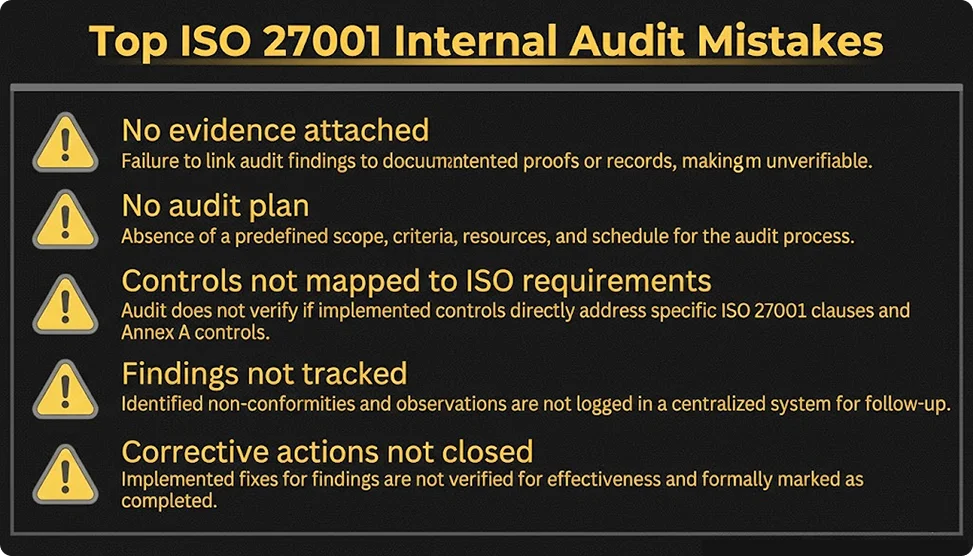
Make sure the person doing the audit is separate from the work they check. Like, an IT person should not check the IT rules they made. If it's hard to find someone inside your company who is separate, think about using staff from a different team. Or you can hire an outside expert to do the internal audit for you.
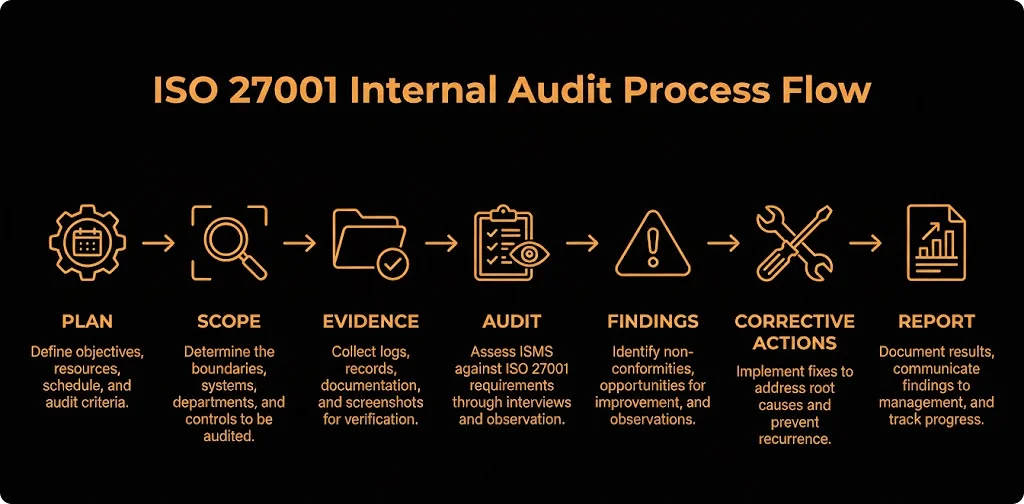
Make a strong plan for your audits. This plan should list all parts of the ISO 27001 rules (like sections 4 to 10) and all the safety steps you chose from Annex A. Make sure you check all of these areas over about one year. Check areas or safety steps that have higher risks more often.
Check if the rules actually work, not just if they exist on paper. Your audit must see if the rules and steps are really being used. And if they work well. Talk to staff. Watch how things are done. Look at computer records and settings. Find real proof that the safety steps are helping manage risks like they should.
Find real proof. Use records, computer logs, and things you see for yourself. Don't just trust what people say. This helps show if controls are truly effective.
Look for problems, but also ways to improve. See what is wrong (these are called nonconformities). But also find chances to make your ISMS work even better. These are opportunities for continual improvement.
Write down what you find in a clear way. Make reports that are easy to read and understand. Give enough details so people know how to fix the problems (these are corrective actions). Document everything well.
Fix the problems that are most important first. Deal with issues based on how big the risk is. Later, check to see if the fix actually worked well. This makes sure corrective actions are effective.
Share what you find with the leaders. Use the audit results when managers talk about the ISMS. This helps them make smart choices to improve the system during management review meetings.
Help your auditors be good at their job. Make sure they are trained on the ISO 27001 rules and how to audit. If you need help, think about hiring outside experts to do your internal audits to add value.
Use computer tools to help. Think about using special software to manage the audit process. These tools can help keep track of what you find and the steps taken to fix things. This can streamline your internal audit work.
How much does it cost to be ISO 27001 compliant?
Achieving ISO 27001 compliance involves significant investment, not just audit fees. Costs include internal staff time for implementation, potential consulting fees, necessary technology tool investments, and the fees charged by the certification bodies for the initial audit, annual surveillance audits, and triennial recertification audits. The total varies widely, generally ranging from tens of thousands to over a hundred thousand dollars over a three-year cycle, depending on organizational size and complexity.
Can I do ISO 27001 compliance myself?
Yes, it is technically possible to implement ISO 27001 compliance using only internal resources if you have the necessary expertise and dedicated time. However, the standard’s clauses and annex controls require specific knowledge in information security management system implementation and risk assessments. Many organizations find hiring consultants or using GRC automation tools streamlines the process significantly compared to a purely DIY approach, which can be time-consuming and prone to errors.
Is ISO 27001 compliance mandatory?
No, ISO 27001 compliance and certification are not legally mandated for most organizations globally. It is a voluntary international standard. However, it is often required by contractual agreements with customers, partners, or within specific regulated industries. While certification is voluntary, if you choose to pursue it, then meeting all ISO 27001 requirements checklist, including conducting ISO 27001 internal audit requirements, becomes mandatory for achieving and maintaining the certification.
How to get an ISO 27001 compliance certificate?
To get an ISO 27001 compliance certificate, you must first fully implement an ISMS conforming to the ISO 27001 standard. This involves defining scope, performing risk assessments and treatment, implementing controls from your statement of applicability, developing documentation, training staff, performing an iso 27001 internal audit, and conducting a management review. Then, engage an accredited certification body for the external audit process (Stage 1 documentation review and Stage 2 main audit). Successful audits lead to certification issuance.
We help businesses prepare audit documentation, close gaps, and get certified faster.