
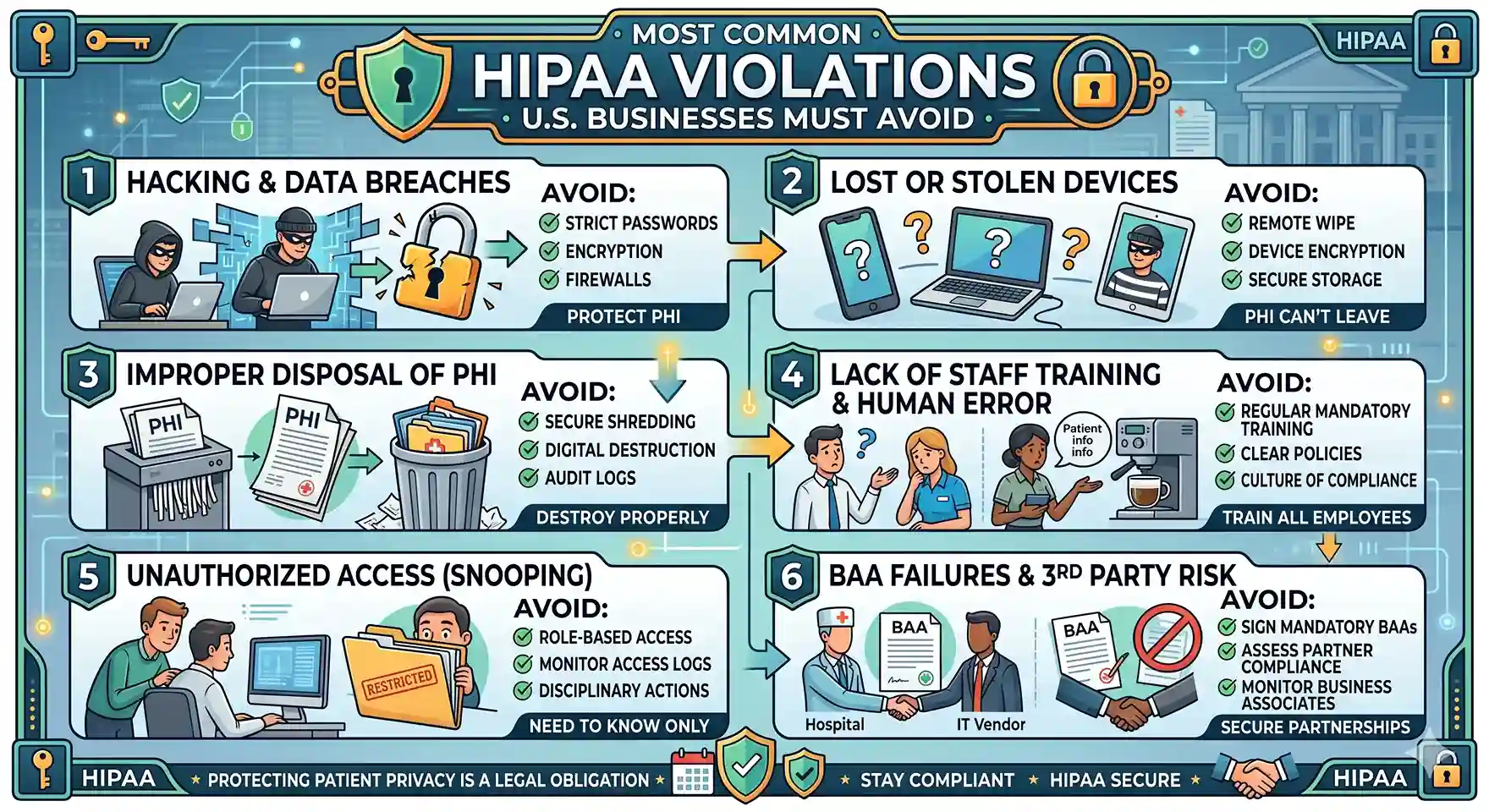
Handling patient data comes with serious responsibilities. In case your business stores or handles medical records, any simple error might lead to fines or lawsuits. Numerous organizations continue to commit the same mistakes over the years. These recurring errors can be referred to as Common HIPAA Violations. These may include unprofessional retention of records and poor cybersecurity standards.
This guide describes some of the most frequent violations that businesses face, why they occur, and what the actual risks you should know about. Knowing them, you will be able to secure your business, protect patient data, and minimize the risk of expensive fines.
The Short Answer
The 12 most common HIPAA violations in 2026 include failure to conduct risk analyses, poor security risk management, and insufficient access controls, with OCR imposing fines up to $3.5 million for severe breaches. Over 70% of HIPAA violations stem from cybersecurity lapses rather than paperwork errors, often due to lack of encryption, weak access controls, or inadequate employee training. The majority of penalties result from unaddressed risks and poor compliance practices, leading to data breaches and costly settlements. Businesses should prioritize regular risk assessments, robust security measures, and ongoing staff training to avoid these violations. Healthcare organizations can find local HIPAA compliance support in Miami and Charlotte.
Key Takeaways: Common HIPAA Violations You Must Avoid
- The majority of HIPAA violations occur because of poor cybersecurity rather than paperwork errors.
- Lack of risk analysis and risk management is among the largest reasons for punishment.
- Absence of encryption, ineffective access controls, and employee training are all risk factors of breaches.
- The Office of Civil Rights (OCR) imposes severe punishments, which can be massive HIPAA fines and settlements.
- Violations are usually identified by breach reports, complaints or random audits.
- Powerful administrative and technical and workforce controls aid in mitigating long-term compliance risk.
- The collaboration with the seasoned channel partners assists companies in enhancing security without having to take everything in-house.
Why Common HIPAA Violations Matter for Your Business
Violations occur more frequently than business owners assume. In this case, “common” means violations OCR has penalized repeatedly across multiple organizations. Being aware of these trends will enable you to prevent mistakes promptly and save yourself from HIPAA non-compliance fines.
- The HIPAA Privacy Rule regulates the collection, storage, and sharing of PHI (Protected Health Information). Companies should restrict access to patient information and only allow authorized individuals to access it.
- The HIPAA Security Rule is concerned with electronic protection. The majority of violations are considered as this rule, and it implies that cybersecurity failures, such as the lack of encryption devices or access controls, are the most significant threats.
- The HIPAA Breach Notification Rule stipulates that breaches should be reported promptly. Any delay or bad reporting may lead to huge fines and settlements.
The majority of the business believes that HIPAA is paperwork, but that is not the case. The root cause is usually cybersecurity lapses, the absence of training of the workers, and poor risk analysis. Knowing these rules would help you know where to focus.
The 12 Most Common HIPAA Violations With Real OCR Penalties
Failure to Conduct an Organization-Wide Risk Analysis as a Common HIPAA Violation
This is a HIPAA violation committed by a business when it fails to conduct a complete risk analysis to find risks to ePHI in systems and workflows.
It is important to a business owner or CTO since unidentified risks usually result in a data breach and impose direct HIPAA fines. The Office for Civil Rights (OCR) has fined HIPAA multi-million dollars and implemented a corrective action plan in case organizations had not conducted proper assessments.
This occurs in the majority of cases because of a lack of visibility into the systems, documentation, or any formal risk assessment process that is not in line with the U.S. Dept of Health and Human Services (HHS) guidance. Nonetheless, Defend My Business collaborates with channel partners who can perform formal risk assessment based on such frameworks as NIST 800-30 that can be used to detect the gaps at an early stage.
Failure to Manage Security Risks as a Common HIPAA Violation
It is a HIPAA violation that occurs when risks are determined but not managed with the help of appropriate risk management.
In the case of leadership teams, this has continuous exposure, as the known vulnerabilities have the potential to result in a recurring unauthorized access or ransomware attack. The Office of Civil Rights (OCR) has been settling substantial amounts of money where organizations have not responded to the identification of risks.
Mostly, this problem is experienced in most organizations because of limited resources, poor prioritization, or the absence of clear ownership of remediation activities. Nevertheless, channel partners could contribute to it by establishing formal risk management initiatives, workflow patching, and ongoing monitoring.
Insufficient ePHI Access Controls as a Common HIPAA Violation
This is a HIPAA violation in which the systems that have ePHI are not subject to proper access controls.
To a CSO or an IT leader, weak controls augment the chances of internal abuse and external infiltration. The Office for Civil Rights (OCR) has fined HIPAA in cases where health records have been exposed due to the absence of Role-Based Access Controls (RBAC).
This is normally attributed to common logins, the absence of audit logs, or the inability to use the least privilege access. However, channel partners are able to implement RBAC, Multi-Factor Authentication (MFA), and monitoring tools in order to mitigate risk.
Employee Snooping on Healthcare Records as a Common HIPAA Violation
This is a HIPAA violation where the employees gain access to the medical records without a legitimate work explanation. This poses legal risk and harms patient trust to business owners.
The Office of Civil Rights (OCR) has imposed HIPAA fines in instances in which employee snooping led to disclosure that was not allowed. This is usually because of the poor monitoring, training, or rather, the lack of a strict access policy for the employees.
The channel partners are, however, able to install monitoring systems, impose access records, and facilitate continuous training programs.
Missing or Non-Compliant BAAs as a Common HIPAA Violation
This is an example of a HIPAA violation where the business associate agreement (BAA) is absent or not in compliance.
In the case of businesses dealing with vendors, this makes them share liability.
The Office for Civil Rights (OCR) has had settlement agreements with cases of covered entities that have not been able to obtain proper BAAs. This mostly comes about because of the oversight of the vendor or not understanding who qualifies as a business associate.
Nevertheless, channel partners may assist in contract review and verification of all vendor relationships that adhere to the requirements of the BAA.
Exceeding the 60-Day Breach Notification as a Common HIPAA Violation
This breach of HIPAA happens when the organization does not comply with the time frame for breach notification. To executives, the delays create greater legal risk and it results in more fines by HIPAA.
Under the HIPAA Breach Notification Rule, the Office for Civil Rights (OCR) has fined companies that had not reported breaches within the stipulated time.
The majority of the delays occur because of poor process definition, the absence of incident response procedures, or slow internal reporting. Nevertheless, channel partners may assist in the establishment of incident response processes and automated alerts.
Failure to Encrypt ePHI on Portable Devices as a Common HIPAA Violation
This is a HIPAA violation that takes place when ePHI on the portable device is not encrypted. To IT leaders, devices that are lost or stolen pose a direct threat of data breach.
The Office for Civil Rights (OCR) has announced major HIPAA fines in the incidents of unencrypted drives and laptops. This normally occurs because of the old policies or the non-enforcement of encryption standards such as AES-256.
But the channel partners will be able to implement encryption tools and Mobile Device Management (MDM).
Impermissible PHI Disclosures as a Common HIPAA Violation
The HIPAA breach in this case is caused by the sharing of PHI (Protected Health Information) without its authorization. In the case of businesses, it results in non-conformity and loss of patient trust.
HIPAA fines have been imposed on the Office of Civil Rights (OCR) when inappropriate disclosures were made through email or social media. Usually, this occurs because of human error or a lack of clear communication policies in most cases.
However, channel partners are able to deploy Data Loss Prevention (DLP) solutions and policy management solutions.
Improper Disposal of PHI as a Common HIPAA Violation
This breach of HIPAA happens when medical records or health records are not destroyed in a secure manner. In the case of operations teams, this poses both physical and virtual exposure risks.
According to the Office for Civil Rights (OCR), HIPAA penalties have been issued where the records were discovered in public places. This normally occurs because of the absence of disposal policies or the mismanagement of the vendors.
Nevertheless, channel partners are able to establish compliant disposal programs and certified shredding or data destruction programs.
Denying Patient Access to Records as a Common HIPAA Violation
This HIPAA breach happens when the patients are not provided access to their medical records as promptly as possible.
This is a direct breach of patient rights as stipulated by the HIPAA Privacy Rule to business owners. The Office of Civil Rights (OCR) has enforced more and fined HIPAA through its Right of Access initiative. This usually occurs because of sluggish internal processes or no clear response procedures.
Nonetheless, channel partners would be able to assist in automating record access systems and simplifying the request-handling process.
Insufficient Employee Training as a Common HIPAA Violation
This breach of HIPAA occurs when employees are not trained in appropriate HIPAA techniques of dealing with PHI. In the case of leadership, the untrained employees are more likely to lead to unauthorized access and mistakes.
Settlement agreements have been made by the Office for Civil Rights (OCR) regarding repetitive errors made by employees. This occurs in the majority of organizations through a single-time training or obsolete materials.
But channel partners can offer training programs and compliance tracking systems that are ongoing.
Non-Compliant Third-Party Technologies as a Common HIPAA Violation
This breach of HIPAA happens when the tools, such as tracking scripts or cloud platforms, do not meet the HIPAA requirements. In the case of CTOs, this poses an invisible risk, particularly in the case of ePHI manipulation by external systems.
The Office for Civil Rights (OCR) has received reports about such cases as tools such as Meta Pixel that revealed patient information. This normally occurs because of not having a vendor review or business associate agreement (BAA) coverage.
Nevertheless, channel partners may evaluate technologies, make sure that they are compliant, and that they may substitute the dangerous tools with safer ones.
3 Ways OCR Uncovers Common HIPAA Violations
Breach Reports to HHS That Reveal Common HIPAA Violations
This discovery trigger starts when a data breach is reported to the U.S. Dept of Health and Human Services (HHS). As a result, the Office for Civil Rights (OCR) will automatically investigate the incident in order to establish whether a violation of HIPAA has taken place. This is important to business owners and CTOs since there is hardly a single breach. Rather, it tends to reveal underlying risk analysis weaknesses, lax access controls, or a lack of encryption.
In most instances, one reported incident explodes into a full investigation. Consequently, companies are more likely to receive increased HIPAA fines, particularly when loopholes demonstrate a tendency of ignorance or inadequate risk management. That is why powerful internal procedures, quick identification, and appropriate breach notification is essential to reduce the harm in the long term.
Patient or Employee Complaints That Lead to Common HIPAA Violations
The event of this discovery prompt takes place when a patient or employee brings a complaint to the Office of Civil Rights (OCR) within 180 days of the event. In the majority of cases, such complaints refer to unauthorized access, the delay in access to the medical records, or the disclosure of the PHI (Protected Health Information) that is not permitted. This is important to business leaders since a minor internal problem can soon evolve into an official regulatory inquiry.
The OCR then assesses the adherence to the HIPAA Privacy Rule and other compliance mandates by the organization. Therefore, the same complaints or cases that have not been managed well are likely to result in audits, HIPAA fines, or even corrective actions. This implies that operational errors that may be committed on a daily basis, particularly those that may involve employees, have actual compliance risk.
Proactive Audits That Identify Common HIPAA Violations
This problem’s trigger is based on the audit program of OCR, where organizations get to be selected without any prior notice. In contrast to breach-based audits, these audits are aimed at general HIPAA compliance, such as documentation, risk assessment, and technical safeguards. This is important to CSOs and compliance teams, since gaps tend to be manifested in those aspects that are not given much attention in the day-to-day running of the company.
Audits in most instances reveal poor risk management, lack of protective measures as required by the HIPAA Security Rule, or incomplete business associate agreement (BAA) documentation. Organizations can therefore not afford to solely use reacting to incidents. Rather, they have to be ready at any time, as audits do not need a breach or a complaint to commence.
How To Prevent Common HIPAA Violations?
Common HIPAA Violations can be prevented with the help of clear policies and effective system controls. The majority of problems occur when companies fail to follow simple steps or postpone. In such a way, the organized strategy contributes to the minimization of the fines imposed under HIPAA regulations, the security of PHI (Protected Health Information), and the continuous compliance with HIPAA regulations.
Administrative Controls to Prevent Common HIPAA Violations
Annual Enterprise-Wide Risk Analysis
- Perform a complete risk assessment of all the systems that store or process ePHI.
- Determine weaknesses in access controls, storage, and data handling.
- Conform to the product of the U.S. Dept of Health and Human Services (HHS).
- Report current findings to prevent recurrent HIPAA breaches.
Risk Management Policy
- Develop an official risk management plan to deal with the risks identified.
- Assign priority to high-impact vulnerabilities that may cause a data breach.
- Allocate risks per risk and monitor the progress of resolutions.
- Review policies tend to mitigate compliance gaps in the long term.
Current BAAs With All Vendors
- Maintain updated business associate agreement (BAA) documents with all vendors.
- Ensure all business associates handling medical records meet compliance requirements.
- Review contracts regularly to avoid hidden liability risks.
- Document all vendor relationships clearly.
Documented Incident Response Plan
- Build a clear response plan for detecting and handling security incidents
- Establish containment, investigation, and breach notification steps.
- Train teams on how to act speedily and minimize delays in reporting.
- Exercise the plan to make sure that it is ready in the event of actual incidents.
HIPAA Privacy Officer
- Have a compliance lead in charge of HIPAA compliance.
- Check on employee activity in PHI (Protected Health Information).
- Keep up with regulatory developments and enforcement patterns.
- Make sure internal policies are aligned with the existing compliance standards.
- Technical Controls to Hinder the Violations of HIPAA, which are common.
Technical Controls to Prevent Common HIPAA Violations
RBAC and Least-Privilege ePHI Access Architecture
- Install Role-Based Access Controls (RBAC) in every system.
- Restrict health records access according to job roles.
- Check usage of the monitor systems via audit logs.
- Lessen internal unauthorized access.
AES-256 Full-Disk Encryption
- Implement AES-256 encryption in all devices that store ePHI.
- Lock all portable devices, such as laptops and external drives.
- Secure data in lost/stolen devices.
- Reduced exposure to reportable cases of data breaches.
MFA on Every System That Accesses ePHI
- Turn on Multi-Factor Authentication (MFA) on all user accounts.
- Implement an additional security measure for passwords.
- Secure ePHI storing or processing systems.
- Minimize the threat of stolen credentials and system infiltrations.
Audit Logging on All ePHI-Touching Systems
- Monitor every access and activity on systems that manage ePHI.
- Keep records of each user’s access to medical records.
- Track logins to determine who is illegally accessing the system.
- Internal audits and support compliance audits.
MDM With Remote Wipe
- Implement Mobile Device Management (MDM) on all the devices that store or access ePHI.
- Allow the erasure of PHI (Protected Health Information) in the event of the loss or theft of a device.
- Implement device-level security measures, such as screen lock and updates.
- Minimize the risk of not secured or uncontrolled use of portable devices.
DLP for Email, Cloud Storage, and Endpoint Data
- Install Data Loss Prevention (DLP) systems in email, cloud systems, and endpoints.
- Keep a check on the illegal distribution of medical records and health records.
- Identify disclosure that is not allowable prior to data exiting the system.
- Enhance security against unintentional spillages and internal abuse.
Workforce Controls to Prevent Common HIPAA Violations
Role-Based HIPAA Training
- Conduct HIPAA training according to roles and levels of access.
- Pay attention to the work with PHI (Protected Health Information) and preventing HIPAA breaches.
- Periodic training on new threats and compliance changes.
- Completion of the track to assist audit readiness.
Phishing Simulation and Security Awareness
- Conduct phishing tests to check the reaction of employees to threats.
- Employees of the train should be trained to detect suspicious emails and deny unauthorized access.
- Raise the awareness of such risks as ransomware and credential theft.
- Minimize human error as one of the common causes of data breaches.
Social Media and PHI Communications Policy
- Develop explicit social media information sharing rules.
- Restrict postings or discussion of PHI (Protected Health Information) in the open.
- Train the staff about safe communication.
- Eliminate unintentional unauthorized disclosure.
Formal Patient Records Request Process
- Set up a programmed system of processing medical record requests.
- Make sure that there is timely access in accordance with the HIPAA Privacy Rule.
- Monitor requests to prevent delays that may result in HIPAA sanctions.
- Enhance openness and patient confidence.
Certified Data Destruction
- Use certified methods for disposing of health records and stored data
- Prevent improper disposal of sensitive information
- Dispose of certified vendors in order to destroy them safely.
- Keep records to be audited by compliance.
Frequently Asked Questions About Common HIPAA Violations
What Are the Most Common HIPAA Violations Organizations Face?
The most prevalent HIPAA Violations are the inability to conduct an adequate risk analysis, poor access controls, the absence of encryption, and the absence of business associate agreement (BAA) coverage. Employee training is also another problem facing organizations in most cases, resulting in unauthorised access or illegal disclosure of PHI (Protected Health Information). The Office for Civil Rights (OCR) has fined several covered entities several times. So, the majority of violations are not single cases of operational failure, but a recurring issue.
What Are the Fines for Common HIPAA Violations?
According to the level of willful neglect, intent, and severity, the fines imposed by HIPAA differ. Overall, fines are between hundreds and millions of dollars, depending on the HIPAA violation. The tiered penalty system imposed by the U.S. Dept of Health and Human Services (HHS) is that the higher tiers are imposed in case of repeated or unheard violations. Organizations also incur other expenses, including legal expenses, settlement compensation, and corrective action plan needs, which come in the long-term in most instances. Consequently, any one breach of data can have a huge financial implication.
How Do Common HIPAA Violations Get Reported to OCR?
The Office for Civil Rights (OCR) receives most of the HIPAA Violations via three avenues. First, companies are required to disclose data breaches according to the breach notification rule. Second, complaints associated with access to medical records or misuse of PHI (Protected Health Information) can be presented by patients or employees. Third, the OCR has proactive audits without any prior notice. Hence, the violations are frequently identified even when the businesses do not directly report them.
Can Business Owners Be Held Personally Liable for Common HIPAA Violations?
There are certain cases when business owners and executives can be personally liable. This is typically applicable in cases of intentional misuse of PHI (Protected Health Information) or the lack of action despite awareness of risks. The Department of Justice (DOJ) can intervene in severe cases, particularly in cases where the violations are accompanied by fraud or intentional abuse of health records. Leadership accountability is, therefore, an important element of HIPAA compliance.
Which Common HIPAA Violations Result in Criminal Charges?
In intentional acts, criminal charges are usually used for serious violations of HIPAA. They are unauthorized access to medical records with knowledge, sale of PHI (Protected Health Information), or personal use of patient information. Under these circumstances, the Department of Justice (DOJ) can initiate charges, and this might lead to a fine or imprisonment. Consequently, the danger is not limited to civil HIPAA fines in case of intent.
How Can Organizations Prevent Common HIPAA Violations?
Companies can stop the prevalent HIPAA Violations by integrating robust policies with technical controls. To begin with, they should undertake periodic risk assessment and have an organized risk management procedure. They should then employ encryption, access control, and constant system monitoring of ePHI systems. Furthermore, continuous employee education decreases human error and enhances compliance awareness. Lastly, companies ought to collaborate with reputable partners in order to enhance their security posture, as prevention needs to be a continuous endeavor among people, processes, and technology.
Want help getting your compliance program right?
Defend My Business helps SMBs cut through the marketing and get their compliance program right for their environment, budget, and compliance needs — then deploy and manage it. Through our 400+ vendor network we can often secure better pricing and terms than buying direct, and we stay vendor-neutral, so the recommendation fits you, not a sales quota. Want a second opinion? Pair this with our compliance services or talk it through with an advisor.
Book a free call with a DMB advisor →