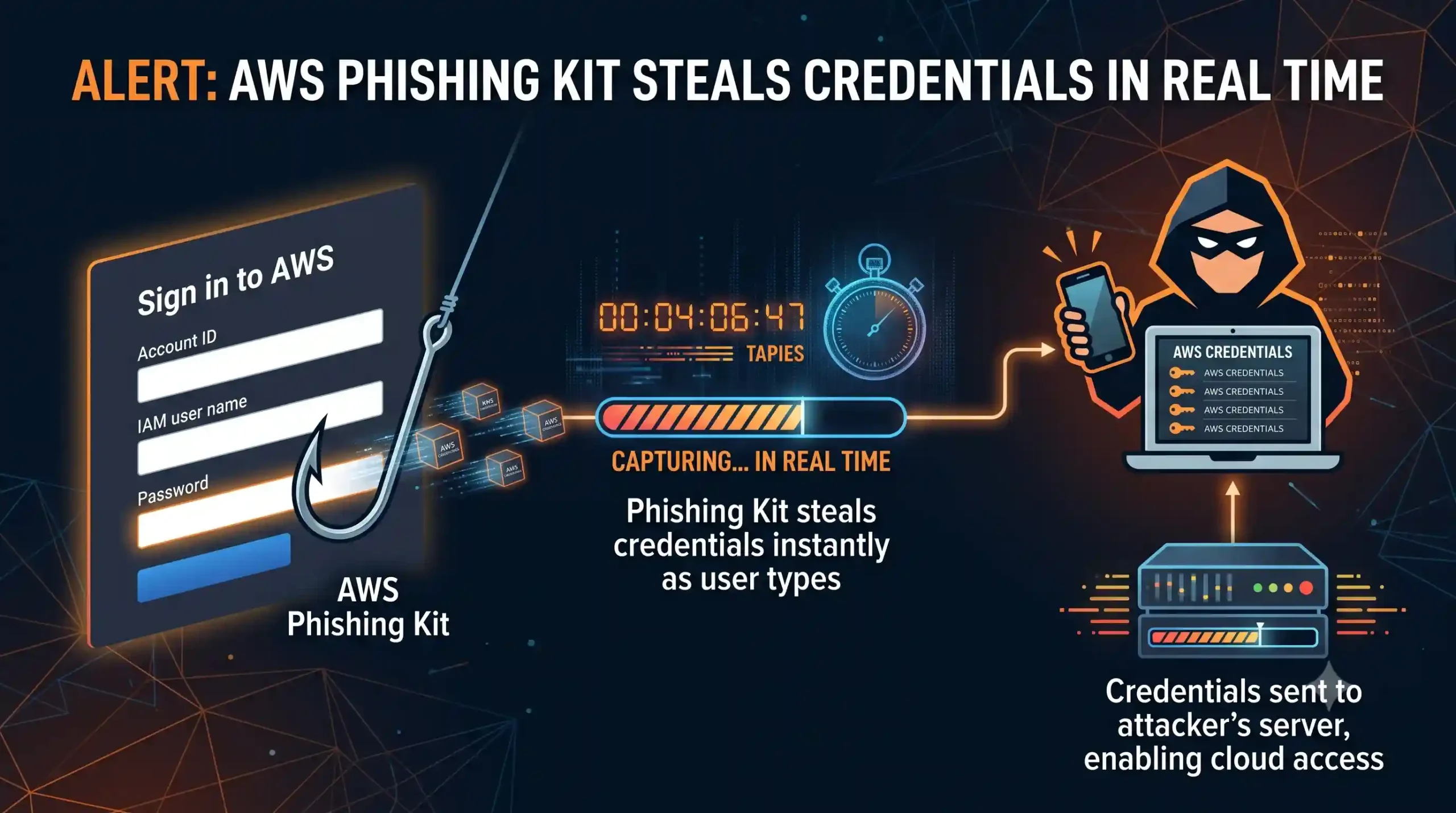
An AWS phishing kit steals credentials and multi-factor authentication codes in real time by intercepting user input during login. Small-to-mid business owners risk immediate account takeover and data breaches if they don’t monitor for suspicious npm package activity or implement additional security measures.
The Short Answer
AWS phishing kits can steal credentials and multi-factor authentication codes in real time, allowing immediate account takeover; small-to-mid businesses should enable MFA on all AWS accounts and audit third-party npm packages within 24 hours to mitigate risks. The attack exploits malicious npm packages that intercept user input during login, enabling attackers to access the AWS console before users realize they’ve been compromised. Immediate action is critical as breaches can lead to data loss, regulatory fines, and operational disruptions. Businesses should conduct free security scans and implement automated monitoring to detect suspicious activity. Phishing and email security support is also covered on our local pages for Dallas, Orlando and Cincinnati.
AWS Phishing Kit Steals Credentials in Real Time
What Happened
A newly discovered phishing kit targeting Amazon Web Services (AWS) users silently steals login credentials and multi-factor authentication codes the moment a victim types them. This attack was first reported on 2026‑06‑25 by Tushar Subhra Dutta, who documented that attackers can access an AWS console before the user realizes anything. The kit differs from older tools that captured passwords for later use; it operates in real time, allowing immediate exploitation of compromised credentials. The incident highlights a new threat vector against cloud platforms, especially those relying on MFA.
What We Know
The phishing kit utilizes malicious npm packages that intercept user input during AWS console login. It captures both standard credentials and MFA codes, enabling attackers to bypass authentication barriers instantly. Tushar Subhra Dutta’s analysis also notes the emergence of a new wave of malicious npm packages targeting developers working with cloud and serverless infrastructure. This aligns with recent findings about the Shai‑Hulud payload—an Hades malware family that has expanded its reach to the Leo/RStreams ecosystem, widely used for AWS-native event streaming and data pipelines. The attack vector is therefore a combination of phishing and package-based exploitation, emphasizing the need for vigilant monitoring of third-party dependencies.
vendor-shortlist
Why This Matters for Your Business
The immediate access to an AWS console can lead to unauthorized data extraction, configuration changes, or deployment of malicious code. Small businesses often rely on cloud services without dedicated IT teams, making them more vulnerable. The loss of sensitive data may trigger regulatory fines and damage customer trust, potentially resulting in significant revenue loss and operational disruptions. Even a single breach could expose confidential financial information, jeopardizing compliance with industry standards like GDPR or HIPAA. The threat underscores the necessity for robust security practices across all cloud environments.
What You Should Do Right Now
Within 24 hours, audit your AWS accounts for any unusual activity, enable MFA on all user accounts, and review third-party npm packages used in your development environment. Immediately run a free security scan to identify vulnerabilities in your codebase and dependency list. In the following week, implement automated monitoring of login attempts and logs, enforce strict access controls, and patch any identified weaknesses. Over the next 30 days, consider deploying endpoint security solutions and secure cloud infrastructure services to mitigate future risks.
endpoint-security
The Bigger Picture
This incident signals a growing trend in malicious npm packages targeting cloud developers, especially those working with serverless architectures. The attack demonstrates that attackers can exploit real-time credential theft by combining phishing with package-based vulnerabilities. Businesses should monitor third-party dependencies, keep their environment updated, and adopt comprehensive security monitoring to anticipate similar threats. Future attacks may involve more sophisticated techniques such as token hijacking or credential injection.
Key Takeaways
- Enable MFA on all AWS user accounts immediately to reduce credential theft risk.
- Conduct a free security scan of your codebase to detect malicious npm packages.
- Audit logs and monitor login attempts for suspicious activity.
- Deploy endpoint security solutions and secure cloud services.
- Update third-party dependencies regularly and keep them vetted.
How Defend My Business Can Help
Defend My Business offers a network of over 400 vetted technology providers that match businesses with pre‑validated vendors for cloud security. We can help you select the most relevant services, such as endpoint security solutions or secure cloud infrastructure offerings, tailored to mitigate this threat category. Start by running a free security scan and contact us at https://defendmybusiness.com/contact-us.
free-security-scan
Sources
Tushar Subhra Dutta
Tushar Subhra Dutta
Tags: AWS, phishing, cloud security, small business cyberrisk, DefendMyBusiness advisory
Recommended Email Security Vendors
DefendMyBusiness partners with a curated network of 400+ vetted providers. Here are 4 currently active in our channel ecosystem for email security:
| Vendor | Specialty |
|---|---|
| vCom Solutions | vCom empowers channel partners to deliver comprehensive IT lifecycle management solutions that drive value for their customers. |
| XTIUM | At XTIUM, we do more than support your Clients' IT – we integrate, secure, and optimize it. |
| ECI | At ECI, cybersecurity is the foundation of everything we do. |
| Ntegrated | At Ntegrated we believe every company deserves to have the best possible work experience, regardless of what they do and where they do it. |
Get a free tailored shortlist – we match you with 3 of these vendors based on your size, industry, and priorities. 24-hour turnaround, no obligation.
Q: How quickly can an attacker gain access to my AWS console after logging in?
A: The phishing kit captures credentials and MFA codes instantly, allowing attackers to log into the console before you realize anything. In practice, this means that a single login attempt could be exploited within seconds.
Q: What cost does a breach of AWS credentials typically incur for a small business?
A: While exact figures vary, breaches can lead to regulatory fines, loss of customer trust, and potential revenue loss due to unauthorized data access. Small businesses may face significant financial penalties if they fail to comply with industry regulations.
Q: What preventive steps can I take without an IT team?
A: Enable MFA on all accounts, run a free security scan to identify vulnerable packages, audit logs for unusual activity, and consider adopting endpoint security solutions that require minimal configuration.
Q: Are specific industries more susceptible to this type of attack?
A: Businesses that heavily rely on cloud services and serverless architectures—such as SaaS providers, fintech companies, and e-commerce platforms—are particularly vulnerable due to their reliance on third-party npm packages and complex authentication flows.
Run a Free Security Scan
See exactly where your business is exposed to threats like the one in this article. Plain-English report, no credit card, no sales calls.
Want help getting your email security right?
Defend My Business helps SMBs cut through the marketing and get their email security right for their environment, budget, and compliance needs — then deploy and manage it. Through our 400+ vendor network we can often secure better pricing and terms than buying direct, and we stay vendor-neutral, so the recommendation fits you, not a sales quota. Want a second opinion? Pair this with our email security solutions or talk it through with an advisor.
Book a free call with a DMB advisor →