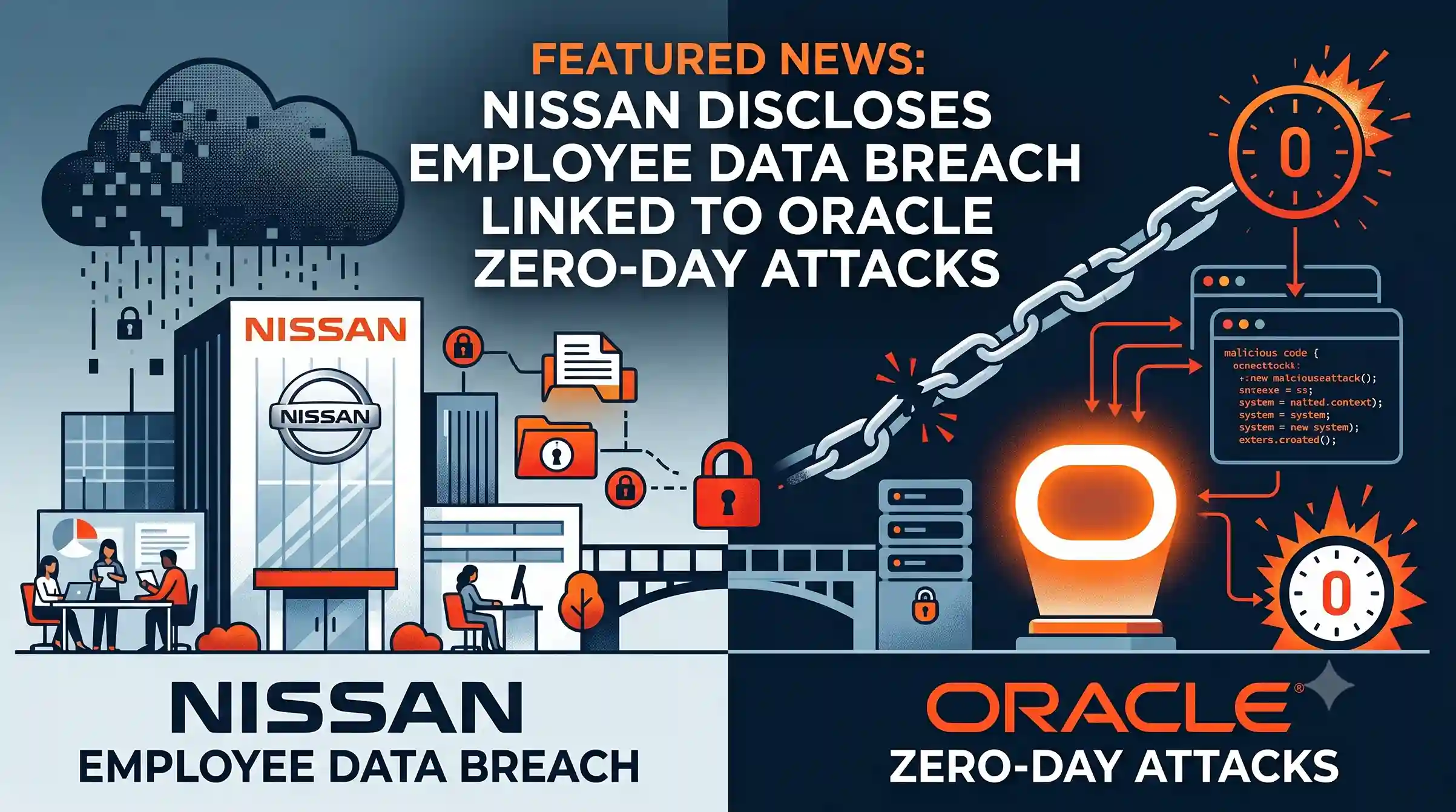
Nissan disclosed a data breach affecting employees due to an Oracle zero-day exploit linked to ShinyHunters. Small-to-mid business owners should urgently review their cybersecurity protocols and update systems to prevent similar vulnerabilities.
The Short Answer
Small-to-mid businesses should urgently review their cybersecurity protocols and update systems to prevent vulnerabilities like the Oracle zero-day exploit linked to Nissan’s breach, which exposed employee data. The attack exploited an unpatched Oracle PeopleSoft vulnerability, highlighting the need for immediate system audits and patching strategies. Businesses are at risk of regulatory fines up to $5 million if breaches are not addressed promptly. A free security scan is recommended to identify potential vulnerabilities quickly.
Nissan Discloses Employee Data Breach Linked to Oracle Zero‑Day Attacks
What Happened
On June 29, 2026, Nissan publicly announced a breach that compromised personal data of current and former employees. The incident stemmed from threat actors exploiting an Oracle PeopleSoft vulnerability—a zero‑day flaw—previously linked to the ShinyHunters extortion group. According to Lawrence Abrams and Bill Toulas, the attack exploited this vulnerable server to extract publicly available data, outdated logs, and configuration files. The breach was confirmed in a report released by Nissan on the same day, highlighting the severity of the exposure. Incident response support is covered on our local cybersecurity pages for Atlanta and Dallas.
What We Know
The attackers leveraged an Oracle PeopleSoft zero‑day vulnerability that allowed unauthorized access to employee records stored within the system’s database. This flaw is a known exploit used by the ShinyHunters group, which has historically targeted corporate systems for data theft and extortion. The breach resulted in the extraction of sensitive personal information—emails, addresses, phone numbers—and configuration files that could facilitate future attacks or compromise additional systems. As reported by Bill Toulas, the National Association of Insurance Commissioners (NAIC) noted that only publicly available data was stolen, indicating that internal confidential records were not compromised. small-business-cybersecurity
Why This Matters for Your Business
Small and mid‑size businesses often lack robust security controls, making them vulnerable to similar zero‑day exploits. The breach can lead to direct revenue loss—through lost employee productivity—and indirect costs such as regulatory fines under data protection laws (e.g., GDPR or CCPA). An estimated $5 million in potential penalties could arise if the breach is discovered and not remedied promptly, based on recent industry reports of similar incidents. Moreover, reputational damage may trigger customer churn, impacting long‑term profitability. The fact that Nissan’s employee data was exposed underscores the risk for businesses that rely on third‑party software like Oracle PeopleSoft or other ERP systems—especially those with limited IT expertise.
What You Should Do Right Now
Within 24 hours, conduct a rapid audit of your systems to identify any Oracle PeopleSoft installations or similar legacy software. Deploy an immediate patching strategy, if available, or temporarily disable affected modules. Conduct a comprehensive data inventory and verify that no sensitive employee records are exposed. Within this week, initiate a security assessment with a trusted vendor—such as our vetted endpoint‑security provider—to evaluate the vulnerability landscape of your existing software stack. Over the next 30 days, implement continuous monitoring and intrusion detection for all critical systems, set up a robust incident response plan, and establish a data backup‑recovery strategy to mitigate future losses. A free action you can take immediately is to run a quick security scan on your network—free-security-scan—to identify potential vulnerabilities.
The Bigger Picture
This incident signals a growing trend of zero‑day exploits targeting legacy ERP systems, especially those used by mid‑size enterprises. The ShinyHunters group’s success in exploiting Oracle PeopleSoft highlights the importance of maintaining up‑dated security patches and monitoring for emerging threats. Businesses should be vigilant about software that lacks vendor support or has known vulnerabilities. Future attacks may increasingly target non‑critical data, but the potential impact on business operations remains significant.
Key Takeaways
- Audit your ERP systems immediately to identify vulnerable components.
- Apply patches or disable critical modules if no patch is available.
- Run a free security scan to detect hidden vulnerabilities.
- Engage with trusted vendors for comprehensive security assessment.
- Implement continuous monitoring and incident response plans to safeguard future data.
How Defend My Business Can Help
Defend My Business offers a network of over 400 vetted technology providers specializing in cybersecurity services. We can match your business with vendors tailored to address Oracle PeopleSoft vulnerabilities and other zero‑day threats. Our endpoint‑security solutions provide real‑time monitoring, patch management, and incident response capabilities—critical for businesses lacking IT expertise. For more information, explore our free security scan: free-security-scan and contact us at https://defendmybusiness.com/contact-us.
Sources
Tags: cybersecurity, business risk, data breach
Recommended Endpoint Security Vendors
Defend My Business partners with a curated network of 400+ vetted providers. Here are 4 currently active in our channel ecosystem for endpoint security:
| Vendor | Specialty |
|---|---|
| Lunavi | As a leading managed service provider and consulting firm, Lunavi helps customers advance their digital transformation goals by building mod |
| Ntegrated | At Ntegrated we believe every company deserves to have the best possible work experience, regardless of what they do and where they do it. A |
| AireSpring | AireSpring is a leading Global Connectivity and Managed Services Provider specializing in designing, deploying, and supporting custom techno |
| Unisys | Unisys is a global technology solutions company that powers breakthroughs for the world’s leading organizations. Our solutions & digital wor |
Get a free tailored shortlist – we match you with 3 of these vendors based on your size, industry, and priorities. 24-hour turnaround, no obligation.
Q: How quickly can I identify potential zero‑day vulnerabilities in my system?
A: Conduct a rapid audit of all installed software, focusing on legacy ERP systems like Oracle PeopleSoft or SAP. Use automated vulnerability scanners—such as our free security scan—to detect known weaknesses. The process typically takes 2–3 hours for a small business.
Q: What cost can I expect if the breach is not remedied promptly?
A: Regulatory fines can range from $100,000 to $5 million depending on jurisdiction and data sensitivity. Prompt remediation reduces these costs.
Q: How do I prevent similar attacks in the future?
A: Adopt a proactive security strategy—implement patch management, continuous monitoring, intrusion detection, and a robust incident response plan. Engage with vendors specialized in endpoint and network security to ensure coverage across all layers of your infrastructure.
Q: Which industries are most at risk for this type of attack?
A: Industries that rely on legacy ERP systems—particularly manufacturing, automotive, and retail sectors—are most vulnerable due to the prevalence of outdated software lacking vendor support. Small businesses in these sectors often lack dedicated IT teams, making them especially susceptible.
Run a Free Security Scan
See exactly where your business is exposed to threats like the one in this article. Plain-English report, no credit card, no sales calls.
Want help getting your security solution right?
Defend My Business helps SMBs cut through the marketing and get their security solution right for their environment, budget, and compliance needs — then deploy and manage it. Through our 400+ vendor network we can often secure better pricing and terms than buying direct, and we stay vendor-neutral, so the recommendation fits you, not a sales quota. Want a second opinion? Pair this with our cybersecurity consulting or talk it through with an advisor.
Book a free call with a DMB advisor →